OPENFABRIC / AI NETWORK SYSTEMS
Intelligence should move without limits.
We link full-system simulation to network hardware, so the next AI service can be predicted before it is deployed.
The queue can cross its limit before control completes one round trip.
DCQCN controls each flow after congestion appears. Synchronized MoE traffic can fill the switch buffer first, then pay in marks, rate cuts, loss and tail latency.
Reference study: Kimi K3, 256 trays, 2,048 GPUs. Official model geometry, SimLLM M5 traffic mapping, declared capacity plan.
SIMLLM STUDY / 2026-08-05
Decode pool
PD KV-transfer traffic is not included because milestone M6 is still open. The stage pool count is derived from the visible 30 req/s, 8K input, 1K output capacity plan.
Tokens fan out to experts across multiple paths. The offered load stays distributed and the destination queue remains below ECN Kmin. This calm fan-out is conceptual and precedes the isolated incast replay.
NO CONGESTIONMechanism view 32-way convergence into a 1 MiB buffer at 400G. Animation timing is intentionally slowed and not to scale.
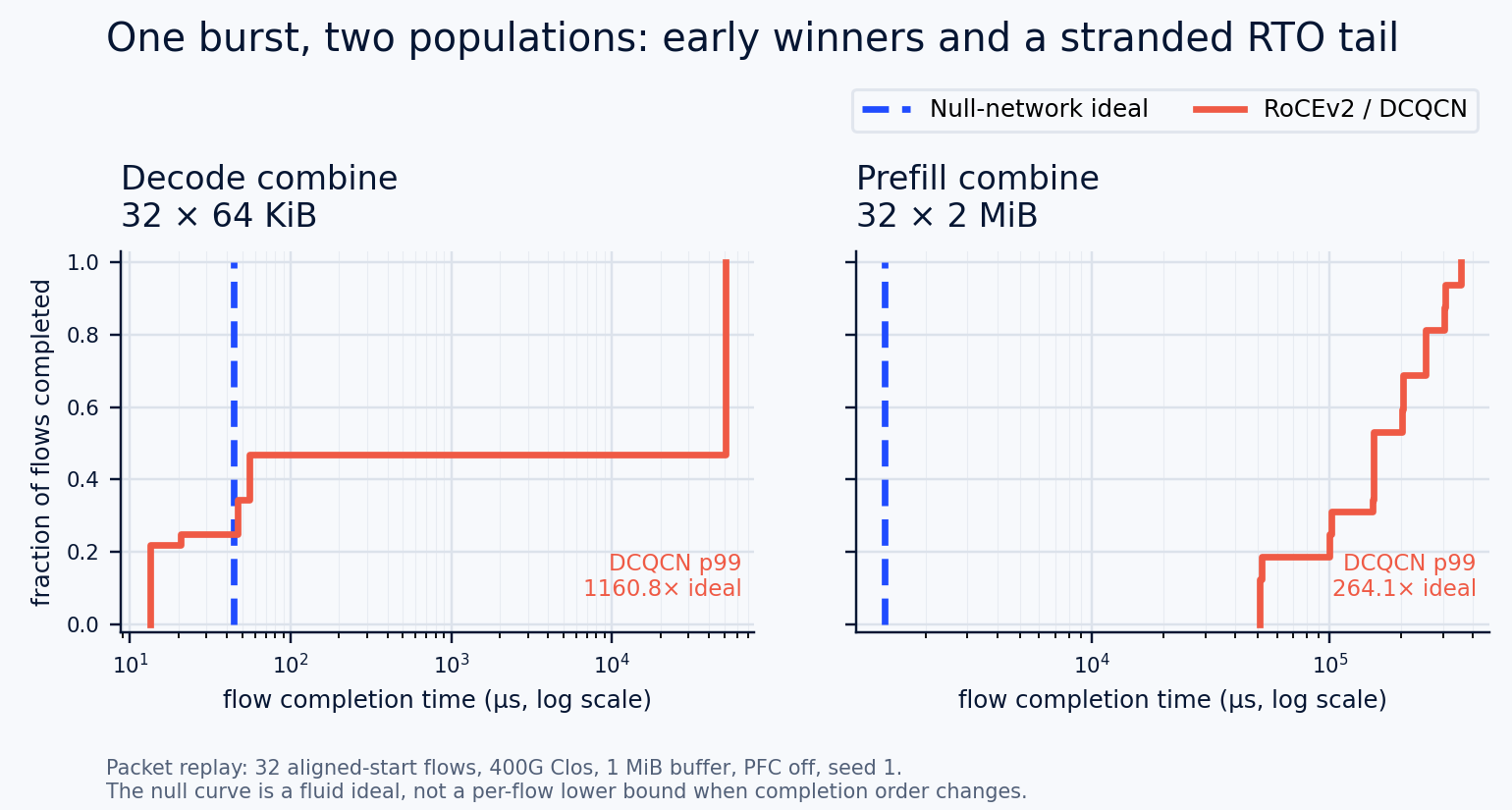
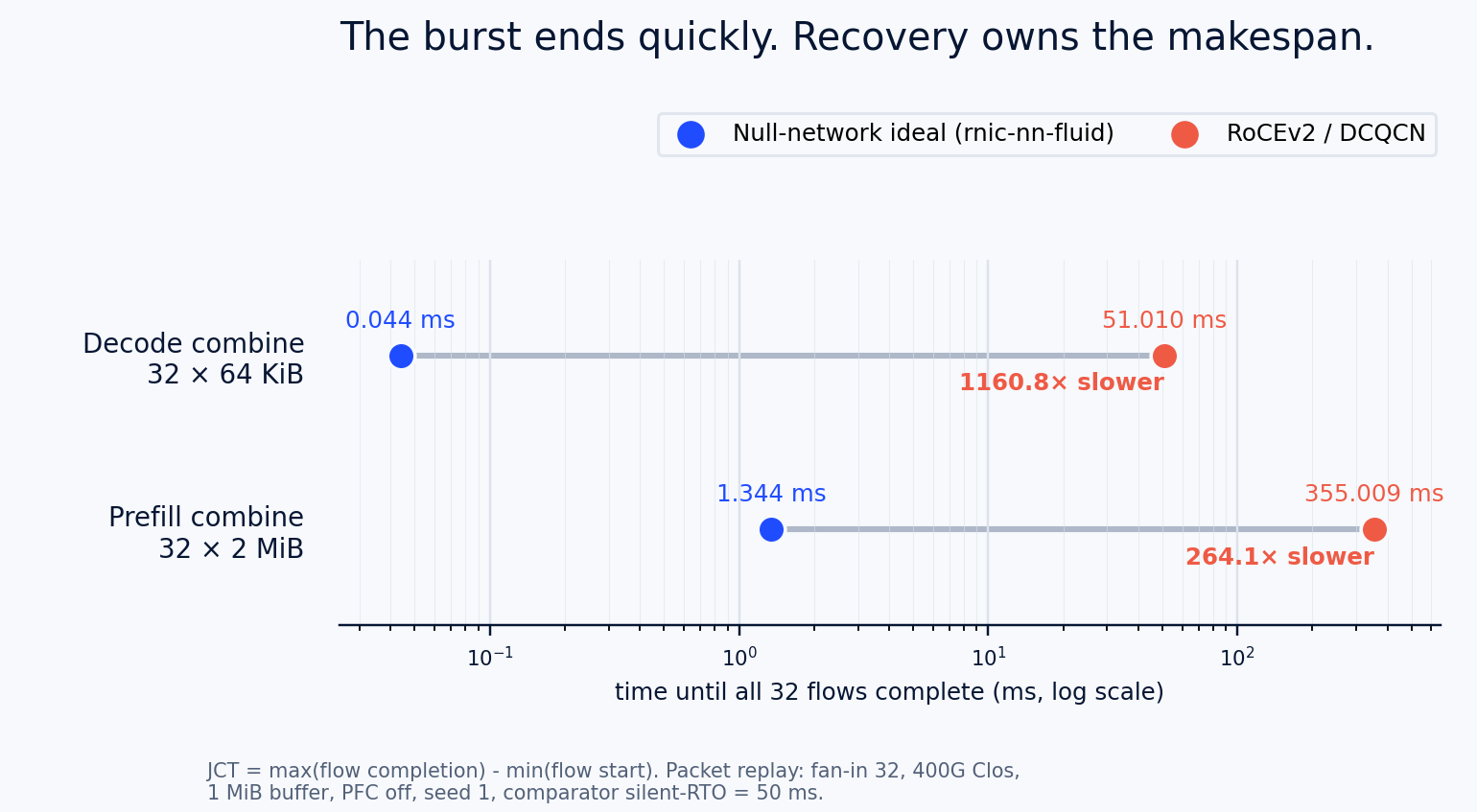
The burst is short. The recovery tail is not.
Packet-level HTSIM replays use identical aligned-start flows, 400G links, a 1 MiB shared buffer, PFC off and seed 1. They are simulation evidence, not measurements from a production Kimi deployment.
Do not wait for congestion to explain itself.
Predict the burst. Schedule the packet. Prove the outcome.
Keep the scheduler real. Simulate the machine beneath it.
SimLLM runs the serving framework’s own batching and cache-control logic, then replaces model execution with calibrated GPU service and packet-level fabric simulation. Every scheduler decision becomes compute and collective work; network completion advances the virtual clock and changes the next decision.
- 01Input
Request trace
Arrivals + token lengths
- 02Runs real
Real scheduler
vLLM / SGLang batching + KV control
- 03Contract
StepRecord
ExecutionLowerer + compute provider
- 04Simulated
ExecutionGraph
GPU, HBM, DMA and resource queues
- 05Causal
Collective trace
TP + MoE dispatch/combine → GOAL
- 06htsim
Packet fabric
Clos + RNIC + congestion control
- 07Feedback
StepResult
FCT → TTFT / TPOT / SLO
Flow and WQE completions advance virtual time, produce TTFT / TPOT, then release the next real scheduler decision.
↺DCQCN p99 / ideal
MANAGE THE WHOLE SYSTEM
Performance is a chain of causes.
Measure where control arrives too late.
Model the gaps that averages cannot see.
Most tools stop at GPU time or bytes divided by bandwidth. OpenFabric keeps the scheduler, queue, GPU, NIC and packet in one mental model.
- Now / WorkloadTTFT / TPOT
Requests and queueing
Arrival processes, prefix reuse and real frontend scheduling drive the request trace.
- Now / NetworkFCT ledger
Collectives and packets
TP, MoE and flow-level work run directly through analytical and packet backends.
- Next / RuntimeCalibrated
GPU, HBM, DMA, WQE and NIC
Explicit resource ownership reveals queueing that a single compute duration cannot represent.
- Next / HardwareBuilt + proved
First-principles packet scheduling
Co-design the protocol and NIC for deterministic, line-rate, lossless operation.
- Future / AgentClosed loop
One-click deployment loop
Pre-study, calibrate, deploy, observe and retune with an agent operating the full system model.
Explore the agentic system
CURRENT DIRECTION
Cobalt / Ink
Closest to the current OpenFabric identity. Select another direction to recolor the complete page.